
The listed fund giving investors access to Sydney’s apartment boom
This interview was filmed 13th March, 2026.
If you live in Sydney, no doubt it feels like residential high-rises are popping up everywhere around the city – and for good reason. Rather than urban sprawl, what we’re seeing in real time is demand and increased density around infrastructure like the Metro, living closer to public transport and closer to facilities, changing the way we live.
It’s also changing where the money flows. Andrew Lockhart has spent nearly 15 years building Metrics Credit Partners into one of Australia’s largest private credit managers and over that time, has seen private credit become a recognised asset class in investor portfolios, sitting alongside equities and fixed income.
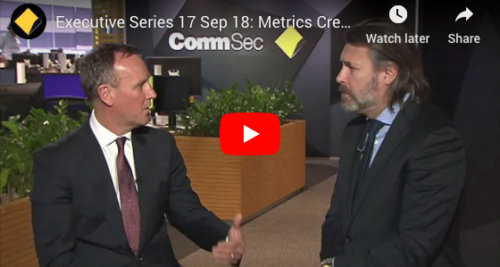
In this interview, we talk about the Metrics Real Estate Multi-Strategy Fund (Fund) (ASX: MRE), a listed investment trust that gives investors access to both private real estate debt and equity, and which invests across the full spectrum of this shift in demographic activities and real estate demand around the country – from high-density residential towers and land subdivisions to industrial developments and retail.
Lockhart breaks down how the fund works and how the firm approaches risk, what’s driving real estate demand, and why the listed investment trust structure might work in investors’ favour right now.

INTERVIEW HIGHLIGHTS
The fund explained
MRE is a listed investment trust on the ASX split evenly between two strategies. Half sits in real estate debt – primarily first registered mortgage, senior secured loans – and the other half is in real estate equity across a range of project types around the country.
“We continue to see demand for residential development sites, financing, land subdivisions, high density apartments, industrial developments, retail, all of the various asset classes around Australia,” says Lockhart.
The debt side generates monthly unfranked income from interest and fees charged to borrowers, which Lockhart says is “designed to provide a regular, consistent income while we dealt with the more lumpy income that comes through the development of projects.”
He explains – “If you think about a real estate development project, it might take 3 to 10 years from acquisition, zoning, planning approvals, construction sale. Most of the projects that we’re involved in are those are much shorter periods than that.
But the intention on the real estate equity side was to provide our investors with unique access to private investment opportunities in privately-owned real estate projects.”
Where the deals are
While around 60% of Metrics’ real estate business is focused on residential development in Sydney, Lockhart also points to other opportunities, such as industrial land in south east Queensland.
An example is a joint venture at Coomera on the Gold Coast Highway, with the acquisition of an industrial site from a foreign public company looking to exit.
“We amended the plan to change the design of the subdivision. So it caters for about 68 industrial landlords… We were able to get expressions of interest for all of the site, and we were able to negotiate a fixed price contract with contractors to undertake the civil works.”
The outcome is a project with a high degree of revenue and cost certainty locked in before construction commences.
“We know what those land lots will sell for. We’ve got a lockdown construction cost. And so when we look at it, we know with a high degree of confidence what our expected profit on that project will be.”
Why private credit is lower risk than most people assume
A common misconception is that private credit sits on the riskier end of the investment spectrum. Lockhart pushes back on this.
“You go and buy a bond, the manager or the person that’s bought that may not necessarily have the ability to structure the terms, the conditions, negotiate the pricing. In a private market, that’s what our role is. We’re actively looking to drive the right return outcome for our investors and to control our risk by taking appropriate action.”
Combined with a diversified portfolio of 150 individual loan positions, Lockhart argues the structure actively lowers investor risk rather than adding to it.
When Lockhart started talking to Australian investors about private credit, most didn’t know what it was. That’s changed considerably over the last 15 years. The asset class has moved from fringe to mainstream, now sitting alongside equities and fixed income in institutional and retail portfolios alike.
But with that recognition has come scrutiny, including a review by ASIC into how managers are treating investor capital. Lockhart’s boils it down to basics about the role private credit managers play:
“Managers are managing client capital, investor capital… And that comes down to appropriate disclosure, transparency, ensuring that if you say you’re going to do something, that you do it.
One way Metrics addresses this is by releasing quarterly portfolio reports available on the ASX, with five years of data for investors to assess the risk profile of the various Metrics funds.
The risks Metrics watches closely
On the debt side, Lockhart points to three key risks: market risk around whether the property will sell, construction and delivery risk, and settlement default risk if buyers don’t complete on pre-sales.
The equity side carries a different risk profile, and that comes down to time, says Lockhart.
“The real impact to our investors on the real estate equity side is things like delays around the project delivery…[it’s] really the time decay between the time you’ve acquired to the time you exit. And that’s about the risk of not being able to move to accelerate the sale and new cash flow.”
The advantages of the LIT structure
Lockhart notes that the LIT structure itself solves a problem unique to private markets – liquidity:
“It’s the best way for an investor to gain access to private markets because often in private markets, there may be less liquidity in the underlying asset. So how does an investor control their need for capital if their circumstances change?”
Lockhart argues this makes the listed structure particularly well-suited to private markets specifically, and less relevant for funds holding public bonds or equities where the underlying assets are already tradeable.
The other aspect investors often misread is the premium or discount to NAV. Rather than a flaw, Lockhart sees it as a feature:
“When you see dislocations of the unit prices, it’s a signal for investors that something’s disconnected between the quoted NAV and market pricing, and that can create an opportunity.”
Disclaimer:
The Metrics Real Estate Multi-Strategy Fund (a stapled structure consisting of the Metrics Real Estate Multi-Strategy Passive Trust ARNS 679 413 293 and the Metrics Real Estate Multi-Strategy Active Trust ARSN 679 413 695) (Fund) is issued by The Trust Company (RE Services) Limited ABN 45 003 278 831 AFSL 235 150 (Perpetual). Metrics Credit Partners Pty Ltd ABN 27 150 646 996 AFSL 416 146 (Metrics) is the investment manager. Perpetual is the issuer of units in each Trust. The information provided in this communication is of a general nature only and has been prepared without taking into account your objectives, financial situation or needs. Before making an investment decision in respect of the Trust, you should consider the current Product Disclosure Statement (PDS) and Target Market Determination (TMD), which are available at www.metrics.com.au/mre, and assess whether the Trust is appropriate given your objectives, financial situation or needs. If you require advice that takes into account your personal circumstances, you should consult a licensed or authorised financial adviser. Neither Perpetual nor Metrics guarantees repayment of capital or any particular rate of return from the Fund. Neither Perpetual nor Metrics gives any representation or warranty as to the currency, reliability, completeness or accuracy of the information contained in this communication. All opinions and estimates included in this communication constitute judgments of Metrics as at the date of creation and are subject to change without notice. Past performance is not a reliable indicator of future performance.
Livewire Interview | 01 April 2026
Other News

RASK Podcast – Metrics Credit Partners’ ASX Listed Strategies
In an interview with Rask Invest, Metrics Credit Partners CEO and Managing Partner, Andrew Lockhart discusses the firm’s three ASX‑listed trusts (MXT, MOT…
Metrics Reaffirms Commitment to Net Zero Asset Managers Initiative
Metrics Credit Partners (Metrics) is proud to reaffirm its ongoing commitment to the Net Zero Asset Managers (NZAM) initiative, strengthening…
INSIGHTS

MCP Income Opportunities Trust (MOT) lists on ASX
Sydney, 29 April 2019: The Trust Company (RE Services) Limited (ABN 45 003 278 831) (Responsible Entity) is the responsible…

MCP Master Income Trust wins Lonsec Listed Fund Award
The award came a year after MXT was listed on the Australian Securities Exchange